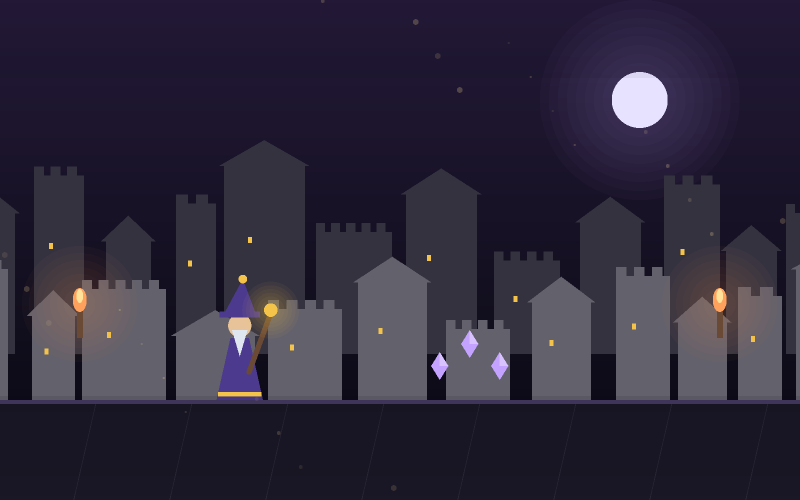
About Magic Castle
Designed rooms, not generated ones
The five rooms are authored layouts rather than procedural ones, because this is a short game and a designed room is worth more than a generated one when the player will only see it for ninety seconds. The Entrance Hall, The Long Gallery, The Rune Vault, The Broken Stair and The Astral Roof each have their own platform arrangement and their own character.
What varies between runs is where the objects and enemies sit inside those layouts. A room is therefore familiar without ever being memorised, and a second attempt at The Broken Stair is a better attempt rather than a replayed one.
The rooms also change realm as you climb: the first two are lit castle interiors, the middle two are dungeon, and the last opens onto the night sky.
The door is the objective, and it says so
Each room's door is sealed until its quota of magical objects is collected, and the number still outstanding is drawn on the door itself. That is a deliberate interface decision: the objective is displayed where the player is looking when they wonder about it, rather than in a corner of the HUD.
Objects are runes, orbs and crystals; the coins scattered alongside them are pure score and do not count towards the quota. Collecting the last object opens the door with an audible cue and a line of text at the door itself.
Clearing a room banks a bonus that includes a time component, so a room solved quickly is worth meaningfully more than a room survived slowly.
Goblins patrol; they do not chase
Every goblin in the castle walks a fixed path between two points and never changes it. Their patrol line is drawn faintly on the floor, which means the timing puzzle can be read rather than learned by dying to it.
That is a deliberate design choice. This is a platformer, and a patrol you can read is a timing puzzle, while a patrol that chases you is a completely different game - one that Monster Escape and Goblin Escape already are.
You can swing the staff at them for points, and doing so is often faster than waiting for a cycle. But nothing forces it, and a careful player can clear all five rooms without defeating a single goblin.
What happens when you lose a life
Touching a goblin or landing on spikes costs a life and returns you to the room's entrance - not to the start of the game. Objects you have already collected stay collected.
That makes a life a real cost in time rather than a catastrophe, which suits a game with designed rooms: the punishment for a mistake should be having to solve that section again, not having to replay the three rooms before it.
Three lives are shared across all five rooms, so the game as a whole still has a budget.
How to play
- Press Space, Enter or tap to start in The Entrance Hall.
- Press Left/Right or A/D to move, Up or W to jump.
- Collect the room's runes, orbs and crystals. Coins are score only.
- The number on the door is how many objects you still need.
- Press Space to swing the staff at a goblin, or wait for its patrol and walk past.
- Walk into the door once it reads OPEN to clear the room.
- Three lives are shared across all five rooms.
Controls
| Where | What to do |
|---|---|
| Keyboard - move | Left/Right arrows or A/D |
| Keyboard - jump | Up arrow or W |
| Keyboard - staff swing | Space |
| Keyboard - pause | Escape or P |
| Touch - move / jump | Tap the sides to move, the top to jump |
| Touch - swing | Tap near the wizard, or the Strike button |
Scoring
These are the point values this game awards, before the combo multiplier is applied where it uses one. Hit quality changes the figure: a strike at the centre of the correct moment is worth substantially more than one at the edge of it.
Tips
- Watch a goblin for one full patrol before crossing. The window is nearly always there.
- The number on the door is the objective. Check it before hunting for something you already have.
- Coins do not count towards the quota. Do not take a risk for one.
- Clearing a room quickly pays a time bonus worth more than most of the treasure in it.
- Losing a life returns you to the room entrance with your collected objects intact.
- The Broken Stair is the hardest jumping in the game. Slow down for it rather than rushing.
Common mistakes
- Trying to outrun a patrol instead of waiting the two seconds for its window.
- Counting coins towards the quota and wondering why the door is still sealed.
- Swinging at goblins on narrow ledges, where the recovery frames put you off the edge.
- Rushing The Astral Roof, which has the largest gaps and the least floor.
- Treating a lost life as a lost run - it costs the room, not the game.
Features
- Five hand-designed rooms with their own layouts and realms.
- A door that displays how many objects are still needed, on the door itself.
- Goblin patrols with their paths drawn, so timing is readable rather than memorised.
- An optional staff swing - the whole game can be cleared without using it.
- Time bonuses that reward solving a room rather than surviving it.
- Room checkpoints: a lost life costs the room, not the run.