

About Magic & Wizard Games games
Cast time is the whole mechanic
Every spell in the library has three phases, exactly like an attack in the battle games. There is a cast - the wizard plants their feet and the staff crystal brightens - during which you are moving slowly or not at all. There is the release. And there is a recovery before you can act again.
The cast phase is what you are trading. A fast spell with a short cast is safe and weak; a heavy spell with a long cast wins fights and loses runs if you start it at the wrong moment. Wizard Run, One-Tap Wizard and Gravity Wizard all vary this trade in different ways, and getting a feel for one transfers directly to the others.
The most common losing habit in this category is starting a long cast because the screen looked calm. Calm is when the next wave is about to arrive. Cast heavy spells when you have just created space, not when you are hoping for it.
Mana, and why running dry is a decision
Mana refills over time rather than on a kill. That means there is a natural rhythm to a run: a burst of casting, then a stretch where you are relying on movement alone. Games in this category are tuned so that stretch is survivable if you have positioned yourself sensibly, and fatal if you have not.
Nothing stops you emptying the bar. The games let you, and then let the enemies do what enemies do to a wizard who cannot cast. Keeping one spell in reserve is not a rule the game enforces; it is a habit that separates long runs from short ones.
The Magic Crystal pickups refill mana instantly, which is why they are placed where they are - usually just past something dangerous. Reaching a crystal is often the correct answer to being out of mana, rather than retreating.
Elements, and reading what a spell will do
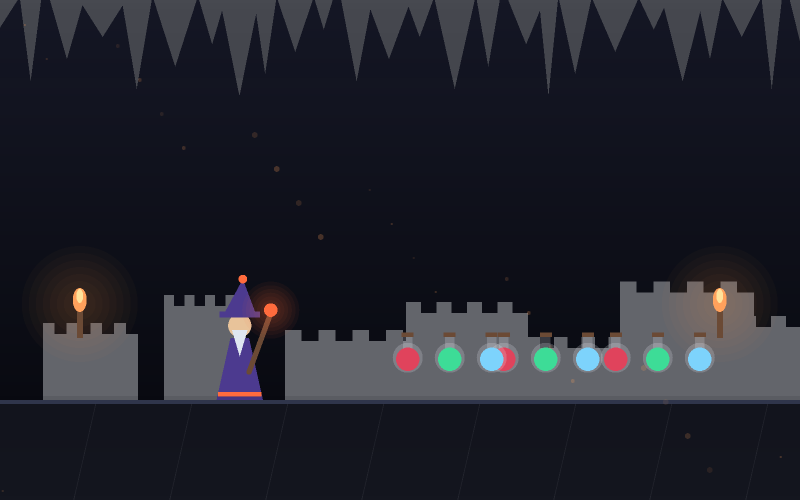
The site uses four elements and keeps their colours fixed everywhere. Violet is arcane: raw damage, no side effect. Ember is fire: it burns over time and destroys breakable scenery. Frost is ice: it slows whatever it hits. Green is life: it heals, and it is the only one that does nothing to an enemy.
Because the colours never change meaning between games, you can walk into a wizard game you have never played and know what the orb floating in front of you will do before you pick it up. That consistency is worth more than variety here.
Elemental matching matters in Potion Rush and Magic Orb Catcher, where the wrong element is not merely less effective but actively costs you the combo. In the other magic games the elements are tools rather than a matching puzzle.
Where to start in this category
One-Tap Wizard is the simplest thing on the site: a single button, a single spell, and a timing window. It teaches the cast-and-recovery rhythm in about thirty seconds.
Wizard Run puts that rhythm into motion, and Enchanted Forest Run does the same at higher speed. Potion Rush and Magic Orb Catcher are the element-matching games and play quite differently from the rest.
Gravity Wizard is the outlier: the spell changes which way down is, and it is the only game in the library where the terrain is the enemy.
Tips for this category
- Start heavy casts just after you have made space, never while you are hoping for space.
- Keep one cast in reserve. An empty mana bar is the most common cause of death in this category.
- Violet damages, ember burns, frost slows, green heals. Those meanings never change between games.
- Magic crystals refill mana instantly and are usually placed just past something dangerous. That is the intended route.
- In the matching games, a wrong element costs you the combo - skipping a bad match is better than taking it.
- Movement is a spell you never run out of. When mana is low, reposition rather than waiting.